

 Celebrity2 books
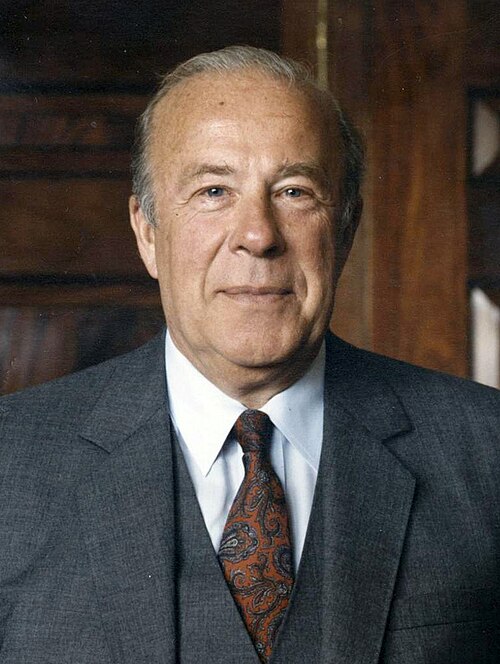
George Shultz
George Pratt Shultz ( SHUULTS; December 13, 1920 – February 6, 2021) was an American economist, businessman, diplomat, and statesman who served in various positions under presidents Richard Nixon and Ronald Reagan. A member of the Republican Party, he is one of only two persons to have held four different Cabinet-level posts, the other being Elliot Richardson. As the 60th United States secretary of state, Shultz played a major role in shaping the foreign policy of the Reagan administration, and conservative foreign policy thought thereafter. Born in New York City, Shultz grew up in Englewood, New Jersey. After graduating from Princeton University, he served in the United States Marine Corps during World War II. After the war, Shultz earned a Doctor of Philosophy in industrial economics from the Massachusetts Institute of Technology (MIT). He taught at MIT from 1948 to 1957, taking a leave of absence in 1955 to take a position on President Dwight D. Eisenhower's Council of Economic Advisers. After serving as dean of the University of Chicago Graduate School of Business, he accepted President Nixon's appointment as United States Secretary of Labor. As secretary of Labor, Shultz imposed the Philadelphia Plan on construction contractors who refused to accept black members, marking the first use of racial quotas by the federal government. In 1970, he became the first director of the Office of Management and Budget, and he served in that position until his appointment as United States Secretary of the Treasury in 1972. In that role, Shultz supported the Nixon shock, which sought to revive the ailing economy in part by abolishing the gold standard, and presided over the end of the Bretton Woods system. Shultz left Nixon's administration in May 1974 to become an executive at Bechtel. After becoming president and director of that company, he accepted President Reagan's offer to serve as secretary of state, holding that office from 1982 to 1989. Shultz pushed for Reagan to establish relations with Soviet leader Mikhail Gorbachev, which led to a thaw between the United States and the Soviet Union. He opposed the U.S. aid to Contras trying to overthrow the Sandinistas by using funds from an illegal sale of weapons to Iran. This aid led to the Iran–Contra affair. Shultz retired from public office in 1989, upon the end of his tenure as secretary of State, but remained active in business and politics. He had already been an executive of the Bechtel Group, an engineering and services company, from 1974 to 1982. Shultz served as an informal adviser to George W. Bush and helped formulate the Bush Doctrine of preemptive war. He served on the Global Commission on Drug Policy, California governor Arnold Schwarzenegger's Economic Recovery Council, and on the boards of Bechtel and the Charles Schwab Corporation. Beginning in 2013, Shultz advocated for a revenue-neutral carbon fee and dividend as the most economically sound means of mitigating anthropogenic climate change. He was a member of the Hoover Institution, the Institute for International Economics, the Washington Institute for Near East Policy, and other groups. Shultz was also a board member of Theranos, with his grandson Tyler Shultz working at the company before becoming a whistleblower about its fraudulent technology. Shultz died at the age of 100 in February 2021.
See your match with George in the app.


Books George Shultz recommends
A curated library compiled from public recommendations, interviews and posts.
More tastemakers
Explore the libraries of other writers, founders and thinkers.
 Robert GreeneRobert Greene (born May 14, 1959) is an American author of books on strategy, power, and seduction. He has written seven international bestsellers, including The 48 Laws of Power, The Art of Seduction, The 33 Strategies of War, The 50th Law (with rapper 50 Cent), Mastery, The Laws of Human Nature, and The Daily Laws. His eighth book, The Law of the Sublime, was published in November 2026.
Born in 1959, Greene studied classical studies and worked a variety of jobs, before his first book was published in 1998. Greene frequently draws on analyses of past historical figures and events throughout his writing. Greene's works have been referenced by a wide variety of celebrities, political figures, and civil rights activists. He is the most banned author in prisons in the United States; many prisons ban his books as a security measure.
 Bill GatesWilliam Henry Gates III (born October 28, 1955) is an American businessman and philanthropist. A pioneer of the microcomputer revolution of the 1970s and 1980s, he co-founded the software company Microsoft in 1975 with his childhood friend Paul Allen. Following Microsoft's initial public offering in 1986 and the subsequent increase in its stock price, Gates became the world's then-youngest billionaire in 1987, at age 31. Forbes magazine ranked him as the world's wealthiest person in their The World's Billionaires list for 18 out of 24 years between 1995 and 2017, including 13 years consecutively from 1995 to 2007. Gates became the first centibillionaire in 1999, when his net worth briefly surpassed US$100 billion. According to Forbes, as of November 2026, his net worth stood at US$121.2 billion, making him the 17th-wealthiest individual in the world.
Born and raised in Seattle, Washington, Gates was privately educated at Lakeside School, where he befriended Allen and developed his computing interests. In 1973, he enrolled at Harvard University, where he took classes including Math 55 and graduate-level computer science courses, but he dropped out in 1975 to co-found and lead Microsoft. He served as its CEO for the next 25 years and also became president and chairman of the board when the company was incorporated in 1981. Succeeded as CEO by Steve Ballmer in 2000, he transitioned to chief software architect, a position he held until 2008. He stepped down as chairman of the board in 2014 and became technology adviser to CEO Satya Nadella and other Microsoft leaders, a position he still holds. He resigned from the board in 2020.
Over time, Gates reduced his role at Microsoft to focus on his philanthropic work with the Bill & Melinda Gates Foundation, the world's largest private charitable organization, which he and his then-wife, Melinda French Gates, co-chaired from 2000 until 2024. Focusing on areas including health, education, and poverty alleviation, Gates became known for his efforts to combat transmissible diseases such as tuberculosis, malaria, and polio. After French Gates resigned as co-chair following the couple's divorce, the foundation was renamed the Gates Foundation, with Gates as its sole chair.
Gates is the founder and chairman of several other companies, including BEN, Cascade Investment, TerraPower, Gates Ventures, and Breakthrough Energy. In 2010, he and Warren Buffett founded the Giving Pledge, whereby they and other billionaires pledged to give at least half their wealth to philanthropy. Named as one of the 100 most influential people of the 20th century by Time magazine in 1999, he has received numerous other honors and accolades, including a Presidential Medal of Freedom, awarded jointly to him and French Gates in 2016 for their philanthropic work. The subject of several documentary films, he published the first of three planned memoirs, Source Code: My Beginnings, in 2025.
 Naval RavikantNaval Ravikant is an Indian American entrepreneur, investor, and podcaster who is best known as the cofounder, chairman, and former chief executive officer of AngelList. An early investor in dozens of successful startups, his early stage portfolio includes major technology companies such as Uber, Twitter, Postmates, and Clubhouse. He achieved widespread global prominence through his philosophical essays and podcast episodes focusing on wealth creation, happiness, decision making, and modern philosophy. Compiled into the bestselling book The Almanack of Naval Ravikant, his insights on leverage, specific knowledge, and digital media have made him a highly influential thinker for entrepreneurs and innovators worldwide.
 Tim FerrissTim Ferriss is an American author, entrepreneur, and angel investor who rose to global prominence with his bestselling 2007 self-help book The 4-Hour Workweek. He has written several other lifestyle and productivity guides focusing on physical fitness, rapid skill acquisition, and entrepreneurial efficiency. As a podcaster, he hosts The Tim Ferriss Show where he interviews world-class performers across diverse fields to deconstruct their habits, routines, and strategies for success. He is also known as an early-stage investor and advisor to major technology companies including Uber, Shopify, and Duolingo.
 Patrick CollisonPatrick Collison (born 9 September 1988) is an Irish entrepreneur, investor, and philanthropist. He is the chief executive officer of Stripe, which he co-founded with his younger brother, John, in 2010. A billionaire since 2016, his net worth as of August 2026 is estimated at $17.5 billion.
Originally from the west of Ireland, Collison won that country’s 41st Young Scientist and Technology Exhibition in 2005 at the age of sixteen. In 2021, he co-founded Arc Institute, a nonprofit research organization, with bioscientists Silvana Konermann and Patrick Hsu. In 2026, he co-founded the Rhine Group, a policy forum and think tank, with former Italian prime minister Mario Draghi.
 Jordan PetersonJordan Bernt Peterson (born 12 June 1962) is a Canadian psychologist, author, and media commentator. He received widespread attention in the late 2010s for his views on cultural and political issues. Often described as conservative, Peterson self-identifies as a classical liberal and traditionalist.
Born and raised in Alberta, he graduated from the University of Alberta with undergraduate degrees in political science and psychology and earned his PhD in clinical psychology from McGill University. After researching and teaching at Harvard University, he returned to Canada in 1998 and became a professor of psychology at the University of Toronto. In 1999, he published his first book, Maps of Meaning: The Architecture of Belief, which became the basis for many of his subsequent lectures. The book combined psychology, mythology, religion, literature, philosophy and neuroscience to analyze systems of belief and meaning.
In 2016, Peterson released a series of videos on YouTube criticizing a proposed federal law, Bill C-16, that would prohibit discrimination against gender identity and expression. Peterson argued that the bill would make the use of certain gender pronouns compelled speech, and related this argument to a general critique of "political correctness" and identity politics, receiving significant media coverage and attracting both support and criticism. The bill became law in 2017. Peterson has been widely criticized by climate scientists for denying the scientific consensus on climate change and giving a platform to climate-change deniers.
In 2018, he paused both his clinical practice and teaching duties and published his second book, 12 Rules for Life: An Antidote to Chaos. Promoted with a world tour, it became a bestseller in several countries. In 2019 and 2020, Peterson suffered health issues related to benzodiazepine dependence. In 2021, he published his third book, Beyond Order: 12 More Rules for Life, resigned from the University of Toronto, and returned to podcasting. In 2022, Peterson became chancellor of the newly launched Ralston College, a private, unaccredited, liberal arts college in Savannah, Georgia, United States. In 2025, Peterson suffered chronic inflammatory response syndrome, causing his hospitalization for five months. Affected by health problems since attaining prominence, Peterson has been under assisted care at his residence and remained out of public life since June 2025. His various lectures and conversations, available mainly on YouTube and podcasts, have garnered millions of views.
